
// ENA EREC G100 · Issue 2 Amendment 2
G100 export limitation — now fully type-tested.
Install more generation than your export limit allows. ENICO's export limitation scheme is fully type-tested to EREC G100 and listed on the ENA Type Test Register — supplied as a standalone panel or fully integrated into your switchgear, with the compliance pack your DNO submission needs.
- Fully type-tested to EREC G100 Issue 2 Amd 2
- ENA Type Test Register · ref. ENICT/19509/V1
- Standalone panel or fully integrated
What is export limitation?
When you apply to connect solar, storage or other generation, the DNO offers an export capacity the local network can take — often less than your system could produce. Without a G100 scheme, that usually means shrinking the system to fit.
An export limitation scheme changes the deal: measure what the site is actually exporting at the point of supply, and automatically rein generation back — by simple disconnection on smaller schemes, or dynamic ramp-down where the site justifies it — before the agreed limit is ever breached. The DNO gets a guaranteed cap; you get to build the system the site deserves.
Why the type-test matters
EREC G100 lets manufacturers have a complete scheme independently tested against its requirements — settable limits, reaction times, fail-safe behaviour, lockout — and entered on the ENA Type Test Register that DNOs check. A registered, type-tested scheme means your application carries test evidence, not assurances: connections are typically accepted on the documentation, with on-site testing only where the DNO chooses to attend.
The ENICO G100 Controller is fully type-tested to EREC G100 Issue 2 Amendment 2 and listed on the ENA Type Test Register — ref. ENICT/19509/V1, checkable by any DNO or client.
How the scheme works
- Step 1
Measure at the point of supply
The scheme meters true site export where the DNO cares about it — the supply intake — not at a single circuit.
- Step 2
Detect the excursion
When export approaches your Agreed Export Capacity, the controller reacts within the reaction times G100 demands.
- Step 3
Act — trip or trim
A simple scheme disconnects generation to protect the limit; a dynamic scheme ramps output down so the site keeps generating. G100/2 allows both — we engineer whichever the site justifies.
- Step 4
Fail safe, always
Loss of measurement, comms or power drives generation to a safe state, and repeated failures lock out until an engineer resets — exactly as EREC G100 requires.
Where it earns its keep
Solar PV oversizing
The DNO offers less export than your roof can produce. Export limitation lets you install the full array and cap what leaves the site — more self-consumption, same connection agreement.
Battery storage (BESS)
Charge and discharge freely on site while the scheme guarantees the grid never sees more than the agreed export — including combined solar + storage arrangements.
Wind, hydro and diesel generation
The same type-tested scheme manages wind, hydro, diesel and CHP sites — and mixed systems where import needs managing as much as export.
// On-panel interface
See what the controller is doing
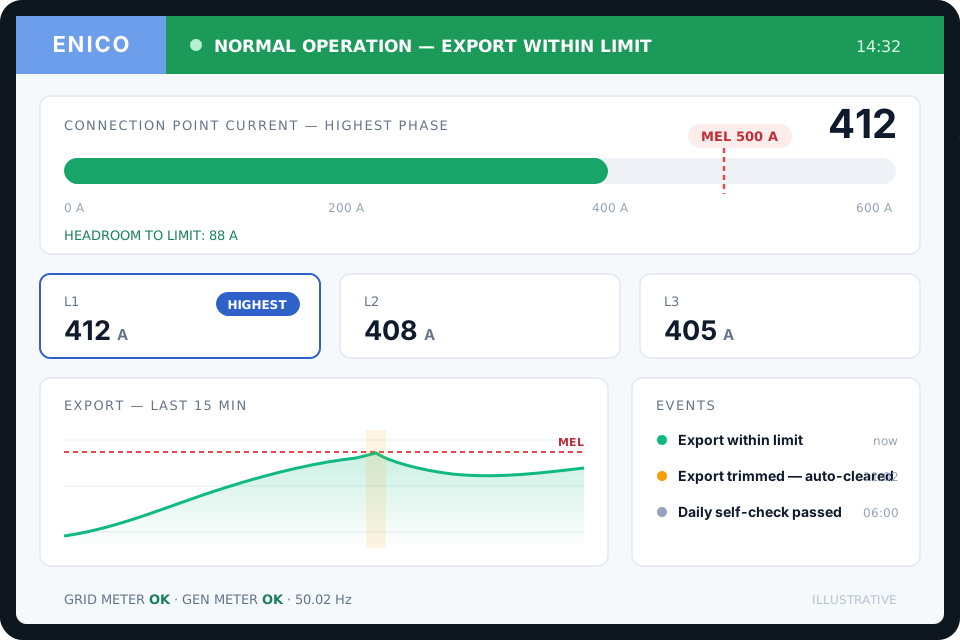
Every ENICO G100 Controller carries its own interface — on the panel display and in the browser for anyone on the site network. One screen answers the questions that matter: how close is export to the agreed limit, what has the scheme done about it, and when.
- Live connection-point current against the MEL, phase by phase
- Trend and event views that make commissioning and witness testing straightforward
- A plain status banner — green means exporting within the limit
Screens shown are illustrative — layouts simplified and values fictional.
Scheme at a glance
| Compliance | Fully type-tested to ENA EREC G100 Issue 2 Amendment 2 (G100/2) · ENA Type Test Register ref. ENICT/19509/V1 |
|---|---|
| Control modes | Simple trip schemes, or full dynamic (active power) control — matched to what the site justifies |
| Format | Standalone wall-mounted panel, or fully integrated into your PVDB, switchboard or control panel |
| Technologies | Solar PV, battery storage (BESS), wind, hydro, diesel generation — mainstream inverters and controllers |
| Measurement | Point-of-supply metering — true site export, single- and three-phase |
| Control interfaces | Modbus RTU/TCP, digital and analogue curtailment signals |
| Behaviour on failure | Fail-safe curtailment and lockout per EREC G100 |
| Integration | Combines with G99 protection, PV distribution boards and metering in one assembly |
| Monitoring | Pairs with the Plantstream platform — IEC 61724-1 Class A-capable solar monitoring |
| Lead times | Standard configurations: short lead times. Bespoke site-specific schemes: typically 5–6 weeks |
| Documentation | Scheme description, settings schedule, Appendix C carrying the register reference |
The paperwork arrives with the panel
A G100 scheme is only as good as the evidence behind it. Every ENICO scheme ships with the documents your DNO expects to see — and they stay one QR scan away on the panel for the life of the installation.
- Verifiable listing on the ENA Type Test Register — ref. ENICT/19509/V1
- Scheme description, settings schedule and single-line diagram
- Completed Appendix C (Form C) carrying the register reference, ready for your DNO submission
- DNO on-site testing supported where the DNO chooses to attend; settings sealed after acceptance
Planning a constrained connection?
Send us the connection offer and your generation schedule — we'll confirm whether G100 unlocks the system you actually want to build, and price the scheme that fits: standard configurations in hours.
Get a G100 quote// Monitoring & verification
See the limit being kept
An export limit you can't see is an export limit you can't trust. Pair the scheme with the Plantstream monitoring platform and the site shows its workings — export against the agreed limit, curtailment as it happens, and an event log a DNO or client can audit.
- Export, generation and curtailment visible — per site and per inverter group
- Every curtailment logged as an event — an auditable compliance trail
- IEC 61724-1 Class A-capable solar performance monitoring
G100 questions, answered
Do I need G100 export limitation?
If the DNO's connection offer caps your export below what your generation could produce, an export limitation scheme under EREC G100 lets you install the full system and stay within the agreed limit — instead of downsizing the array or battery, or paying for network reinforcement.
What's the difference between G99 and G100?
G99 is about protection — disconnecting your generation when the network needs it to. G100 is about limitation — continuously keeping your export (or import) inside the agreed capacity. Many sites need both, and we build them into one panel with one set of documentation.
What does "fully type-tested" actually do for my project?
It means the complete scheme has already been independently tested against EREC G100's requirements and is listed on the ENA Type Test Register — the register DNOs check. Your submission carries test evidence rather than promises, which typically means fewer questions at application stage and faster acceptance.
Will the DNO want to test it on site?
Sometimes — that's their call. Because the scheme is type-tested and registered, DNOs generally accept it on the documentation; some carry out on-site checks as they see fit. If yours does, the panel arrives pre-configured and tested, we support the visit, and settings are sealed after acceptance.
Standalone panel or built into other switchgear?
Either. We supply the scheme as its own wall-mounted panel, or fully integrated into the switchgear it belongs with — a PV distribution board, main switchboard or control panel — sharing metering and protection where that makes the installation cleaner. One assembly, one set of documentation.
Can it integrate with the rest of the installation?
Yes — the export limitation controls can share an assembly with G99 protection, generation metering and distribution. For solar work we regularly build it into the PV distribution board, which means one panel, one delivery and one witness visit.
Which inverters and controllers does it work with?
The scheme controls generation over standard interfaces (Modbus RTU/TCP, digital and analogue signals), so it works with the mainstream solar and battery inverter brands and generator controllers. Tell us what's on your schedule and we'll confirm compatibility with the quotation.
Often combined with
Pricing a G100 scheme?
Send the DNO connection offer and your inverter or generator schedule — we'll quote the type-tested scheme that fits. Standard configurations priced in hours; bespoke site-specific schemes priced properly.